


Visas and Borders
Last updated 23 February 2026
Recent News
ETOA on Visa & Border Access
Tourism relies on efficient visa facilitation and streamlined border processes to drive economic growth and stimulate demand, particularly from emerging markets that require visas.
Before the COVID-19 pandemic, Europe’s share of global international tourist arrivals was already declining, with only around 15% of EU visitors coming from long-haul markets. This represents a significant missed opportunity, given the higher spending patterns and extended seasonality associated with long-haul travelers. Export revenue from long-haul tourism is therefore a vital component of Europe’s visitor economy.
Meanwhile, the attractiveness of non-European destinations is expected to continue rising, making it crucial for Europe to maintain its cross-border mobility. Achieving this depends not only on political commitment and adequate infrastructure but also on effective visa and border management.
In this context, ETOA plays a key role by engaging on visa and border policy, from Schengen, UK, and Ireland visa processing to keeping members informed on cross-border travel requirements, both within Europe and from international markets.
- An objective assessment of risk allowing more countries to have visa-waiver (exempt) status
- Intelligent reform to Schengen visa code and national governments visa policy including development of e-visas
- Efficient and welcoming border processes, including travel documents and any health credentials required
- Inform members on cross-border travel requirements
- Conduct origin market surveys and publish reports
- Collaborate with industry partners including Tourism Manifesto alliance
- Work with European Commission, EU border agencies, European Parliament and national governments and parliaments
- ETOA is a member of the European Commission’s industry advisory group on ETIAS communication
- Respond to official inquiries on border-related issues
- (July 2025) ETOA and partner associations issued a press release expressing concern over the proposed increase of the ETIAS fee from €7 to €20, noting that the fee was originally intended solely to cover operational costs and that the rise may impose an undue burden on travelers.
- (Mar 2024) ETOA submission to inquiry by UK Parliament House of Lords Justice and Home Affairs Committee on electronic border management systems (e.g. ETA). Committee letter setting out their conclusions and recommendations from the inquiry.
- (Jan 2024) ETOA submission to inquiry by UK Parliament House of Commons European Scrutiny Committee on impact of EES and the UK border
Operating in Europe | What you need to know
Schengen Area
The Schengen Area is a group of 29 European countries that have agreed to abolish internal border controls between them, allowing people to travel freely across most of Europe without passport checks at borders.
The EU has established a common visa policy (Schengen visa) for visitors to the Schengen Area for stays of up to 90 days within any 180-day period (short stay). Visits exceeding 90 days remain subject to each country’s national procedures.
- List of countries whose nationals are not required to obtain a Schengen visa (‘visa-waiver/exempt’)
- List of countries whose nationals are required to obtain a Schengen visa.
- Cost: The cost of a Schengen visa is generally €90 per person aged 12 and above. Further information here.
- School trip visa exemption: A student from a visa-required country living in a visa-free country may join a school trip to Europe without a visa. For information on which EU/EFTA member states apply this derogation, see Article 6 (2.1) in the derogations spreadsheet found in the section ‘Countries whose nationals require a visa‘.
Schengen Visa Digitalisation
From 2028, it is anticipated that a single EU online visa application platform will become operational to unify the Schengen visa application procedure. The platform will enable visa requiring nationals to apply for a Schengen visa online, regardless of the Schengen country they would like to visit. Due to a 7 year transition period, it may not be until 2035 when all Schengen member states have joined the platform. Appearing in person at the consulate would only be mandatory for first time applicants for the collection of biometric identifiers, for applicants whose biometric data are no longer valid or those with a new travel document.
The Schengen visa will also be digitalised (replacing the current visa sticker with a cryptographically signed barcode) and introduced when the platform becomes operational.
‘EU Digital Travel Application’
In October 2024, the European Commission adopted proposals to digitalise travel documents (passport and EU ID cards) for travellers to use entering/leaving the Schengen Area. The European Council and Parliament are now discussing whether to agree to the proposals before they can be implemented.
The proposals include the development of an ‘EU Digital Travel Application’ that will be voluntary and free to use by all travellers (EU and non-EU nationals) to store their travel document(s). The app is anticipated to be available from 2030. In the meantime, Schengen member states would be allowed to implement national systems for using digital documents at their borders before the ‘EU Digital Travel application’ is ready for use.
Cyprus has applied to join the Schengen Area and is applying parts of the Schengen acquis such as on external border policy (i.e. 90 days in rolling 180 day period). In 2023, the European Commission evaluation process started to assess the readiness of Cyprus to join the Schengen Area and is ongoing.
Ireland maintains an opt-out from joining the Schengen Area and does not participate in the Schengen acquis on external border policy (i.e. 90 days in rolling 180 day period). However, Ireland does participate in the Schengen acquis related to the Schengen Information System, police and judicial cooperation. For information on visiting Ireland and travel between Ireland and the UK, see below.
For entering Schengen Area (and Cyprus)
- issue date within 10 years on intended date of arrival
- expiry date at least 3 months after intended leaving date
For entering Ireland see below.
EES - Entry Exit System
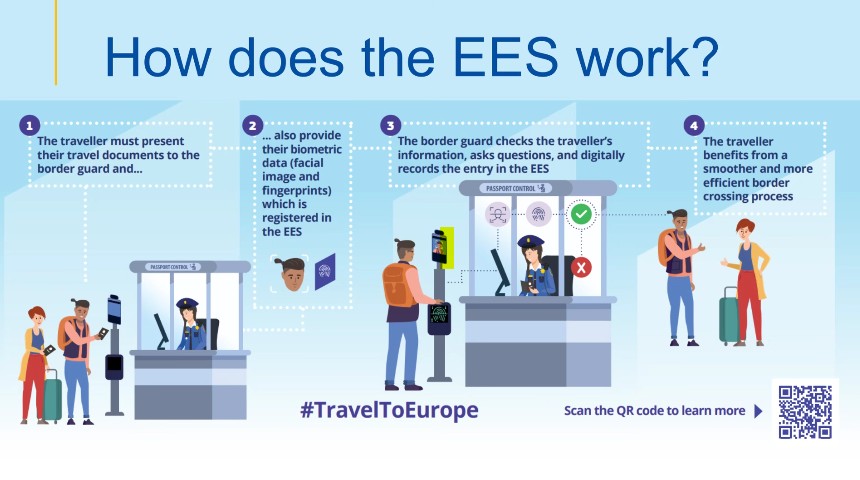
EES is an automated IT system to register third country (non-EU/non-EFTA) nationals visiting the Schengen Area for short stay (max 90 in 180 days), both visa-exempt and visa-requiring.
- Official website: European Commission EES webpage
- Full implementation from 10th April 2026.
- Countries implementing: Schengen Area. See section below for EES implementation: UK outbound
- Countries (EU) not implementing: Cyprus and Ireland
- EES system: Replaces manual passport stamping and collects biometric data:
- Age 12 and above: facial image and/or fingerprints
- Under 12: facial image only
- For frequent visitors, see information on National Facilitation Programmes.
- Mobile app: If permitted at the port of entry, a person may upload their facial image in advance (but not fingerprints) through a mobile app to speed up processing at border control. Information (video) on the mobile app prototype developed by FRONTEX for implementing countries to use.
- Validity: Personal data collected is stored for 3 years and one day after leaving the Schengen Area for majority of third country nationals. When re-entering the Schengen Area and data on file is still stored and valid, new biometric data is not required to be collected.
Eurostar – procedures in London
Eurostar recommends arriving at the station with enough time for ticket checks, security, passport control, and any required EES steps
Pre‑registration kiosks at St Pancras (London).
- At London St Pancras International, non‑EU nationals may be invited to use EES pre‑registration kiosks before border checks.
- These kiosks ask you to scan your passport and register biometrics (face and fingerprints).
- This pre‑registration helps speed up the check at actual passport control.
Border control checks.
- After pre‑registration (if available), you go through usual security and French/Schengen border control (e.g., French police at St Pancras, or Belgian/Dutch border officers depending on destination).
- If you haven’t registered biometrics at a kiosk, border staff will do it during control
Port of Dover procedures
When traveling from Dover to France, non-EU and Third-Country Nationals, including UK passport holders, will need to complete EES registration and biometric checks with French border authorities before boarding their ferry.
This involves:
1. Passport verification – Travel documents will be scanned and registered at kiosks at the Western Docks facility.
2. Biometric enrolment – All Travellers will be required to provide fingerprints and a facial image.
Children under the age of 12 will only have to provide a photo, not fingerprints.
3. Automated record creation – The system will record each entry and exit, including the date and location of travel.
4. Subsequent Travel to the Continent -On all subsequent visits to the Port of Dover, travellers must visit the EES facilities at the Western Docks to verify their EES profile.
The registration process only needs to be completed on a passenger’s first journey after EES comes into force. On subsequent trips, it will still be mandatory for all passengers to visit the EES Western Docks facility, but the system will automatically recognise registered travellers, speeding up the border crossing process.
If a passenger does not subsequently travel again within 3 years, the registration process will have to be completed again.
All coach drivers are advised to arrive at the Western Docks no more than two hours before travel, as they did prior to the EES. implementation.
More info can be found here.
- Partial suspension of EES (i.e., collection of biometrics is not required) is permitted for 90 days.
- Until 8 July 2026, Member States may, at their discretion (e.g., in cases of acute overcrowding – thresholds not defined), suspend EES for up to 6 hours at a time. Each instance must be reported to the Commission.
Additional 60-Day EES Suspension Decision
- A further 60-day period during which partial suspension would be permitted expires on 6 September 2026.
- There is reported to be pressure from Member States as well as industry bodies for the EU to find a way of permitting partial suspension beyond that date.
- The current EES legal framework does not allow the 60-day extension on any other basis, such as industrial action, staff shortages, or system malfunctions. Any remaining national discretion would require a separate legal justification (e.g., public safety), which has not been explored.
ETIAS
ETIAS (European Travel Information and Authorization System) is a travel authorisation permit that will be required to visit the Schengen Area or Cyprus for third country nationals (non-EU/non-EFTA) who do not require a Schengen or Cyprus visa. Examples include travelers from the United Kingdom, Japan, and the United States.
Start date (target): Q4 2026 (specific date to be announced) ***July 2026 update: there is media speculation that implementation will be delayed. We are part of the Commission’s informal consultative body on ETIAS communication, so have written to them requesting clarification and urging a public decision sooner rather than later.
Countries implementing: Schengen Area + Cyprus (30 countries)
Countries (EU) not implementing: Ireland
Applicable to: Third country (non-EU/non-EFTA) nationals of countries with Schengen visa-waiver/exempt status (Annex II). The same start date is planned for all applicable nationalities and there will be a transition and grace period to help with implementation.
Transition period: For at least 6 months from start date, an ETIAS permit will not be a requirement (including for multiple entries during this time).
Grace period: After the transition period, there will also be a grace period of at least 6 months, whereby a person on their first visit to a country implementing ETIAS since the end of ETIAS transition period will not be required to have an ETIAS permit.
Cost: €20 per person aged 18-70 years old at time of application (under 18 and over 70 still need to apply even though free). Family member of an EU/EFTA national (of all ages) are exempt from payment travelling to a country that is not of their family member’s nationality.
Validity: 3 years or until expiration of travel document i.e. passport, whichever is sooner, from ETIAS issue date. Multiple entries will be permitted during period of validity. A standard ETIAS travel authorisation will allow travel to all countries that have implemented ETIAS and will be linked to the travel document i.e. passport.
Transiting: An ETIAS will not be required when transiting the countries implementing and remain in international transit area.
Exemptions: Third country nationals resident within the Schengen Area or Cyprus. Third country nationals resident in Ireland are not exempt (except British nationals resident in Ireland before 1 January 2021). Information on exemptions.
Application process
One application per person (no group booking option)
How to apply (not yet launched): Will be required to receive ETIAS permit in advance of travel; apply either via ETIAS mobile app (in development) or European Commission ETIAS webpage.
Decision on application expected to be less than 1 day (but may take up to 4 days and in some cases up to 30 days)
Third parties e.g. tour operators will be permitted to apply on behalf of a traveller with a declaration of representation, although for children application will need to be submitted by a person exercising permanent/temporary parental authority or legal guardianship.
The third party will be required to upload a copy of the signed declaration to the application form (the declaration can be in English, French, German, or in the official language of the country of which the traveller is a national).
Either ETIAS mobile app or online form will be able to be used to apply.
Dual nationals and multiple passports: A person with two passports both from a third country (non-EU/non-EFTA) will be required to apply for an ETIAS linked to one of their passports. Applying for an ETIAS for each passport will not be permitted.
School trips: ETIAS will be required by nationals of a third country listed in Annex I, residing in a country listed in Annex II, travelling as part of a school trip where a visa is not required. For information on which EU/EFTA member states apply the school trip visa exemption, see Article 6 (2.1) in the derogations spreadsheet found in the section ‘Visa requirements for third countries‘.
Inaccurate information online: Some confusion about scope and operation has arisen due to the proliferation of unofficial websites with URLs containing either Schengen or ETIAS. The official website should always be consulted. European Commission ETIAS webpage.
Latest official information pack:
ETOA additional resources on topic:
- ETIAS & UK ETA summary table showing key similarities and differences between the travel authorisation schemes
Official website (including how to apply when launched):
Pricing policy
- On 24 July 2025, ETOA together with partner associations issued a press release expressing concerns about proposed ETIAS price increase. The stated reason for the increase is cost inflation for the scheme’s operation since the enabling legislation was published in 2018 (with the seven euro fee being agreed years before then). However, alignment with other countries with travel authorisation programmes is also given as grounds for change. This purpose is not anticipated by the legislation.
- Unlike the USA equivalent (ESTA), the revenue was not intended contribute to tourism promotion. Following strong representation from industry, the fee was set at a level to cover costs including development of land border infrastructure as well as the system itself. ETOA and other associations took the view that seeking profit would penalise those who had chosen to visit Europe, and that promotion should be funded in other ways. However, the increase to 20 euros in July 2025 calls this rationale into question.
Ireland and United Kingdom
Ireland and the UK (England, Northern Ireland, Scotland and Wales) have a Common Travel Area (CTA). The CTA includes the Channel Islands and Isle of Man.
Although the maximum stay differs—90 days in Ireland and 6 months in the UK—there are some shared visa arrangements for certain nationalities.
- For example, the British-Irish Visa Scheme allows Chinese and Indian nationals to travel in both Ireland and the UK on a single visa, usually issued by the country of first arrival.
- Additionally, Ireland has a Short-Stay Visa Waiver Programme, which lets nationals of certain countries enter Ireland without an Irish visa if they already hold a UK visa. This programme does not work the other way around; the UK does not offer a similar waiver for Irish visas.
Cost
- The cost of a UK short stay visitor visa is generally £127. Other visa fees can be found here.
- The cost of an Ireland short stay ‘C’ visitor visa is generally €60.
Uk e-Visa Transition
The UK is moving to a fully digital immigration system. From February 2026, most visitors who need a visa gets an eVisa only. This digital immigration status replaces visa vignette stickers in passports. Carriers (including airlines) will verify visitors travel permission via automated digital checks with the Home Office.
Key Info:
- With an eVisa, people only need to attend the Visa Application Centre (VAC) once to confirm their identity.The VAC returns their passport during the appointment. They don’t have to visit again to collect a visa vignette sticker
- Creating a UKVI account gives people online access to their immigration status
- All commercial airlines travelling direct to the UK, cruises, ferries, and UK Border Force for international rail, can automatically check passengers’ permission to travel. It is important that the passport used to travel is correctly linked to their UKVI account.
- Apply for a visa and attend VAC to confirm identity. UKVI will email a decision notification to the applicant, and instructions on how to set up a UKVI account to access their eVisa.
- UK_eVisa FAQs
You can find more info here: eVisa Visitor Toolkit 2026.
For entering Ireland – expiry date after intended leaving date
For entering UK – expiry date after intended leaving date
From Monday 28 September 2026, ferry passengers travelling between the Republic of Ireland and Britain will be required to carry a valid passport. Previously, passengers were generally required to carry some form of valid photo ID.
There are no checks between the republic and Northern Ireland.
While British and Irish citizens do not legally need a passport to travel between the two nations under the Common Travel Area agreement, the ferry measure follows similar airline practices.
Here all the information provided on the Stena Line and Irish Ferries websites.
The UK Government has not yet updated its guidance to reflect this change.
Since 1 October 2021, the EU List of Travellers Scheme has ended for school trips from the EU to the UK. As a result, children of UK visa requiring nationality now require a visa to visit the UK (except on a school trip from France). In addition, EU ID cards are no longer accepted for most visitors and a passport is required (unless exempt or a child on a school trip from France).
Security of new EU ID cards is improving following European Commission regulation in August 2021. ETOA has been campaigning with other industry associations for UK Government to re-instate acceptance of EU ID cards for children under 18, as well as waiving the need for a UK visa for children of visa-requiring nationality on EU/EFTA school trips to the UK. The UK-France Joint Leaders’ Declaration in March 2023 committing to making changes to documentary requirements for children on a school trip from France is welcome, however bilateral agreements of a similar kind with other EU member states have not been announced to date.
School trip from France
From 28 December 2023, documentary requirements entering the UK have changed for children aged 18 or less on a school trip from France (with 5 or more pupils) whereby:
- an EU ID card is accepted for entry instead of a passport
- children of visa requiring nationality do not require a UK visitor visa
These changes are only permitted if a France-UK School Trip Travel Information Form has been completed (further information on the process). A passport is still required for adults supervising the children.
When travelling between Ireland and Northern Ireland, there are no immigration controls at the land border, but travellers must check whether an Irish or UK visa is required for their nationality.
For nationalities that do not require a UK visa, a UK Travel Authorisation (UK ETA) is required in Northern Ireland, depending on nationality. This includes arrivals into Northern Ireland from Ireland, unless the traveller is a resident of Ireland.
- Irish Government – visiting (including visa requirements)
- UK Government – visiting (including visa requirements) | border entry process
ETA (UK Electronic Travel Authorisation)
ETA is a digital authorization required for travelers who do not require a visa prior to traveling to the United Kingdom.
Who needs an ETA?
An ETA is a digital travel permission for visitors who are visiting or transiting landside in the UK and who
- Do not currently need a visa for short stays
- Do not already have UK immigration status
A full list of ETA eligible nationalities can be found on GOV.UK. Carriers will not allow these travelers to board without an ETA.
Note: carriers are legally required to check for a valid ETA and will not allow eligible travelers to board without one.
How to Apply:
- Apply using the passport you will travel with, as the ETA is digitally linked to it.
- Apply either via ETA mobile app or online (process differs between mobile app and online form as facial biometric collected for ages 10+ using the mobile app).
- One application per person (no group booking option)
- Applications are quick and usually processed within three working days, but processing may take longer in some cases.
- Third parties e.g. tour operators are permitted to apply on behalf of a traveller. Either ETA mobile or online form can be used (although applications should be made online where the traveller is not present with the third party). A letter of authorisation is not required to be uploaded with the application.
Support: is available via:
- ETA webchat (Mon–Fri, 9am–5pm UK time)
- Webform outside these hours
Multiple passports: An ETA is linked to each passport and therefore a person can have more than one ETA valid at the same time.
Dual nationals: A person with a British or Irish passport should travel using this passport to demonstrate they do not need an ETA. A US national who also has British/Irish nationality travelling from the USA should use their US passport for check-in but present their British/Irish passport to the carrier for boarding.
Cost: £16 per person (payable by all ages). The revenue is used to cover costs and invest in the UK border system.
Validity: 2 years or until expiration of travel document i.e. passport, whichever is sooner, from ETA issue date. Multiple entries are permitted during period of validity. An ETA allows travel to all countries in the UK and is linked to the travel document i.e. passport.
Transiting: An ETA is no longer required when transiting the UK and remain in international transit area. Only the UK airports – London Heathrow and Manchester have an international transit area where a traveller does not pass through UK border control connecting flights outside UK/Ireland. Further information (London Heathrow | Manchester)
Exemptions:
- Non-British/non-Irish nationals resident in Ireland who do not require a UK visitor visa are exempt when travelling to the UK (Great Britain and Northern Ireland) from Ireland or elsewhere in the Common Travel Area (CTA). An ETA is required when travelling to/via the UK from outside the CTA. To prove residency in Ireland, these documents are accepted.
- Children on school trips from France under the agreed scheme (adults supervising the children still need to apply for an ETA if their nationality is visa-exempt).
Official website: UK Government ETA webpage
- Electronic Travel Authorisation Factsheet November 2025
- Further information: Immigration Rules Appendix
- UK Government communication resources:
- Stakeholder pack including General Factsheet (English | Other languages) and Northern Ireland Factsheet (English)
- Videos – What is an ETA | How to apply
ETOA additional resources on topic:
- ETIAS & UK ETA summary table showing key similarities and differences between the travel authorisation schemes
- Webinar with UK Government held on 2 December 2024
- Summary results of ETOA impact survey in January 2025 to assess potential impact of the UK ETA on tourism in Northern Ireland completed by tour operators/DMCs.
China outbound : Group Visas for Europe
There are schemes for group visas from China to Schengen and UK, whose smooth operation depends on continued collaboration. The requirements are available below:
A 2018 briefing note is available here. Note that it was written prior to the UK’s departure from the EU, so the operations of the schemes may diverge, but the principals remain the same.
ETOA Visa Impact Surveys and Reports
ETOA conducts origin market surveys with its members and publishes reports assessing current impact of Schengen, Ireland and UK visa processing. Its results help ETOA and policy makers map current problems and identify good practice: poor visa processing costs Europe valuable business.
2025-26
Visa Facilitation: Rhetoric vs. Reality, first presented as part of our 2026 Showcase Outbound India programme, shows marked variation within Schengen-issuing states.
European visa facilitation 2022 – 2025 shows relative progress as perceived by outbound Asian markets.
Previous surveys
Presentation from our visa processing survey in autumn 2022 focusing on Asian origin markets can be found below. Findings suggest that Schengen Area countries as well as Ireland and UK need to improve service standards to avoid deterring high-spending Asian visitors.

Disclaimer: While best efforts have been made to verify the accuracy of the information, the information displayed on this page should be used as guidance only.